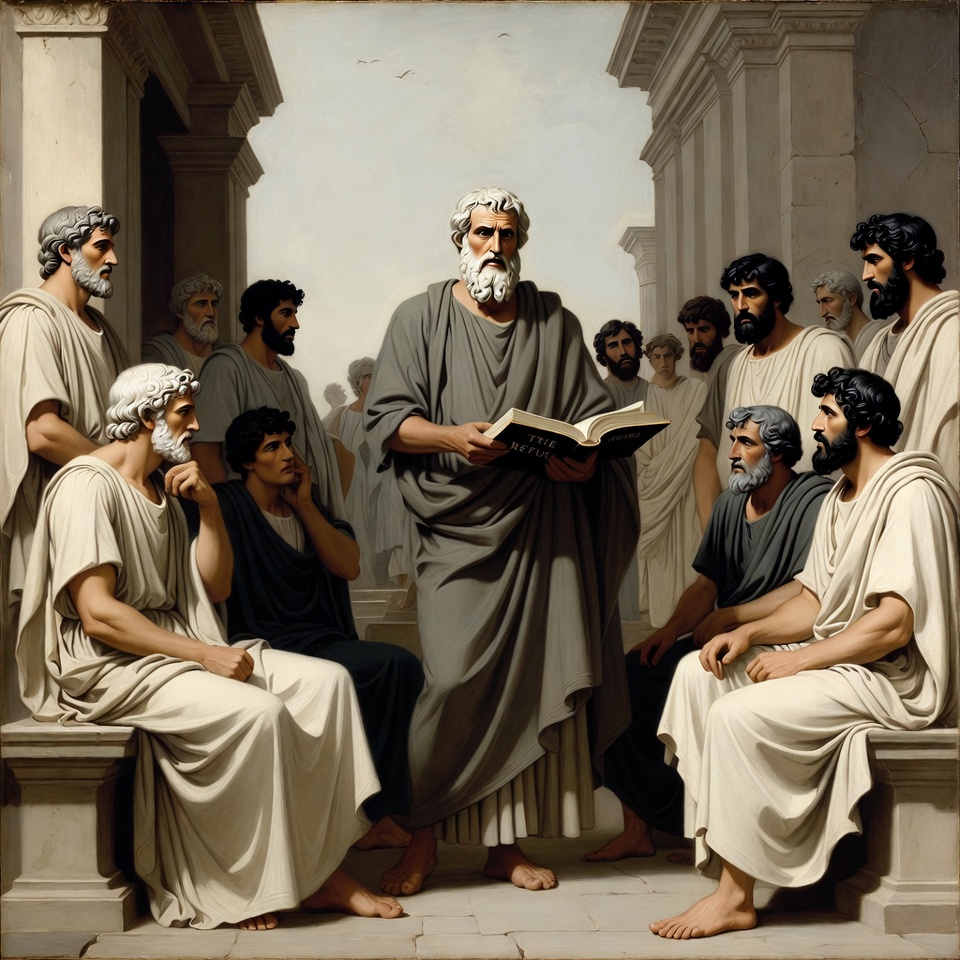
I -Reflections on Plato’s “The Republic”
Introduction:
Each of us, at least once, searches for a book that not only tells us about the world, but also makes us think about ourselves. Plato’s “The Republic”is just such a book. It reveals not so much the structure of an ideal polis as the hidden mechanisms of the human soul, its aspirations and its weaknesses. I would recommend reading it to anyone who considers themselves a thinking person. Not for the sake of agreeing with Plato, but for the sake of that inner movement of thought that only arises where there is disagreement. It is a text that does not let you go — and to which you always return, but as a different person. Reflections on Plato’s “The Republic”
Sometimes I think that books come into our lives for a reason. Some are like accidents. Some are like habits. But Plato’s “The Republic” comes differently. It returns, as if asking, “Well, are you ready to hear a little more than last time?” And every time, I catch myself thinking that I am never completely ready. Because it is not just a text. It is a conversation with something ancient within myself.
I don’t know if everyone experiences this feeling, but when I open The Republic, I get a strange feeling: as if I am entering a room where questions I have long avoided asking myself have been stored for a long time. And Plato, or Socrates — what difference does it make, really? — seems to raise his head and look straight at me. And I feel uncomfortable.
“What is justice?”
A simple question. Almost childish. But as soon as I try to answer, I notice a noise rising inside me: excuses, fears, personal experiences, resentments, doubts. Plato seems to be exposing me. And I understand: justice is not something external. It is a mirror. And it is uncomfortably honest.
I. On justice that is deeper than the law
When I read the first books of the dialogue, I am always struck by how easily people — ordinary, intelligent, sincere people — are mistaken in their definitions. They are confident that they understand the nature of justice. Just like us. One says: justice is helping friends and harming enemies. Another says it is in the interest of the strong. A third says that a just person is one who simply repays debts.
We are still the same, thousands of years later.
We seek justice where there is none.
We build it on profit, fear, and calculation.
But when Socrates begins to dissect these answers, layer by layer, I feel something inside me begin to break. It’s as if he’s not exposing them, but me.
Because deep down, I also believe that justice is when I feel good.
And I also want the world to be the way I want it to be.
And I, too, am inclined to confuse justice with convenience.
Plato does not say this directly, but the feeling remains: justice is the harmony of the inner world, not of external circumstances. When the mind is king in a person. When the will is the guardian. When desires are subordinates. And then the soul works like a well-tuned lyre.
But most people sound out of tune.
Me too.
And perhaps Plato’s ideal state is just a metaphor for how rarely a person achieves harmony with themselves. An internal revolution is much more difficult than an external one.
II. On the state as an enlarged soul
This is where I probably feel Plato most acutely. He makes a gesture that seems simple but is actually genius: he takes the human soul and scales it up to the size of a city. It’s as if he’s saying, “Look at yourself under a magnifying glass.”
Plato’s ideal state is not a political project.
It is an X-ray of human nature.
Philosophers are the mind.
The guardians are the will.
The artisans are the desires.
And if the “state” is sick, it means that one part has grown too large, suppressed the others, and destroyed the harmony.
Don’t we see this within ourselves?
When desires rule, a person slips into chaos.
When the will becomes a dictator, he turns into a harsh fanatic.
When reason is removed, a person lives blindly.
Plato, in essence, draws a map not of a city, but of the soul. He tries to show us what we could be if we lived in harmony with ourselves. If everyone inside us did their own thing.
But we are not like that.
We are in a state of perpetual civil war.
III. On philosophical kings who do not exist
When I first read about the idea of philosopher-kings, it seemed like a beautiful fantasy. But as I grew older, I realized that Plato did not believe that such people would actually appear. He was talking more about a horizon — a direction in which thought should strive.
To rule justly, one must be free from pride and ambition. One must love truth more than power. One must be prepared to lose everything in the name of harmony. And who among us is capable of that?
A philosopher king is not a person.
It is an ideal.
It is an image of someone none of us will ever become, but someone we dream of becoming.
There is something tragic about this. Something very human.
We long for those who do not exist.
IV. Why Plato is a utopian, and why that is wonderful
The more I read The Republic, the more I understand: yes, it is a utopia. Pure, transparent, ideal. Utopian to the point of impossibility. And Plato probably knew it.
1. Utopia, because a person is not a geometric figure
Plato tries to reduce human nature to functions. But we are not functions. We are contradictions. We are dreams and weaknesses at the same time. We cannot be just one thing. We change, we break ourselves, we start over, we lose and we gather ourselves again.
Utopia crumbles at the slightest touch of reality.
2. Utopia, because goodness cannot be imposed
A state in which people are raised “correctly” sounds beautiful. But goodness without freedom is a puppet. A person must have the right to make mistakes, otherwise they are not human.
3. Utopia, because desires do not disappear
Plato believed that desires could be ordered, distributed, and calmed. But desires are not sheep. They do not live in pens. They rebel, overflow, and grow from within.
Prohibitions only delay the storm.
4. Utopia, because ideal order contradicts life
Life is improvisation.
Plato’s ideal is a musical score.
If you follow it too strictly, the music will disappear.
V. But why is this utopia so beautiful?
Probably because humans are creatures who are never satisfied with reality. We are always looking for something higher. Purity, harmony, silence, honesty. Something that does not belong to the world, but belongs to us.
Plato describes not a real state, but our secret longing. Our dream of order within chaos. Our attempt to believe that we can become better than we are.
Utopia is not a mistake.
It is a confession.
VI. About the cave in which we live
When the myth of the cave appears at the end of the dialogue, I feel something inside me fall silent. Because it is not just a metaphor. It is a diagnosis. And it seems to me that each of us is painfully familiar with it.
We sit, chained to the wall by our own fears, habits, and social roles. We see only shadows — our thoughts, our beliefs, our memories. And we are convinced that this is reality.
But someone — one in a million — turns around and walks toward the light.
Plato believes that this person is a philosopher.
But I think differently.
Every person turns around at least once in their life.
At least for a moment.
At least with one inner movement.
And that moment makes us who we are.
VII. About what cannot be named
Perhaps the greatest strength of The Republic is that it does not provide ready-made answers. It makes you think. Move inward. Gather your own understanding of the world.
Justice remains elusive.
The ideal state is impossible.
Truth is distant.
But all of this together makes me live more attentively. More honestly. More subtly.
Plato awakens a feeling that is difficult to describe in words:
the feeling that there is a space inside me where everything can be harmonious.
Even if outside there is chaos.
And this space is mine.
My little utopia that exists for at least a minute.
VIII. A conclusion that is not a conclusion
Every time I close The Republic, I feel a strange mixture of hope and sadness. Hope — because Plato reminds me that a person can strive for the highest. Sadness — because the highest always slips away.
But maybe that’s the point.
Justice is not something we achieve.
It is something we strive for.
Order is not something we establish.
It is something we seek within ourselves.
The ideal state is not a place.
It is a path.
And perhaps the most important thing Plato leaves us with is a quiet, almost whispered thought:
“Start with yourself.
And in that beginning will already be part of the order of the world.”
With gratitude and silence,
Zohar Leo Palffy de Erdod
“Between Thoughts”

Leave a Reply